Archivi tag: manicure

La Nail art durante i vari decenni: dagli anni '20 ai nostri giorni

Bentornati su un nuovo articolo!

Oggi voglio parlarvi delle varie nail art e mode che abbiamo visto durante i decenni, dalla nascita di smalti e prodotti per ricostruzione fino ai giorni nostri.

Iniziamo!

Anni 20

Durante questa decade fu inventato un prodotto che serviva a lucidare le unghie naturali.

Bastava strofinare questa polverina sull’unghia con un pezzo di pelle di daino sull’unghia.

Anche gli smalti colorati iniziavano a fare la loro apparsa, e la nail art più comune in questi anni ruggenti era quella a mezzaluna, o Moon Manicure.

Basta ricoprire tutta l’unghia con il colore desiderato, lasciando scoperto solamente un punto, ovvero quello dove si trova la lunula dell’unghia.

Anni 30

Durante questi anni iniziano a nascere parecchie case cosmetiche che sono arrivate fino ad oggi.

La loro produzione si concentrava dunque su smalti colorati e makeup.

Andava di moda abbinare il rossetto al colore delle unghie.

Gli smalti con formula opaca iniziavano a farsi strada e le prime unghie finte furono inventate.

Come nail art troviamo le unghie con una forma a mandorla, con una linea sottile sul margine libero, creata con l’argento.

Anni 40

Durante questa decade si vedono due tipi di nail art.

Le attrici del grande cinema portavano sulle loro scene unghie abbastanza lunghe rosse e a mandorla.

Invece le lavoratrici comuni per comodità preferivano mantenere le unghie corte e con colori naturali.

Anni 50

Da questo periodo in poi si ha una svolta nel mondo delle unghie.

Viene formulato l’acrilico e inventate le tip, in modo da poter eseguire allungamenti delle unghie naturali.

Come tendenza nail art invece si rimane sempre sull’unghia a mandorla e ovale, con colori rosso-arancionati.

Anni 60

La ricostruzione unghie ha sempre più successo e molte donne desiderano curare le proprie unghie.

Si fanno largo i colori perlati e shimmer, e le unghie iniziano ad avere una forma più squadrata, per avere qualcosa diverso dal solito.

Anni 70

Durante questi anni vengono progettati i primi prodotti fotoindurenti ma bisognerà aspettare fino agli anni 90 per la nascita dei gel.

Nasce la famosissima french manicure.

Quest’unghia dal colore rosato con il bianco sul margine libero risulta molto versatile e adatto a tutti i tipi di look.

Anni 80

Questi sono gli anni più colorati ed eccentrici per quanto riguarda la moda, e anche le unghie seguono questo esempio.

La forma prediletta è lo squoval, un mix tra quadrata e ovale e ovviamente i colori più usati sono quelli vivaci, fluo e accesi.

Le cantanti pop del momento erano di ispirazione con i loro look super vistosi.

Inoltre inventano le unghie Press on, ovvero unghie finte già decorate da applicare con una colla adesiva.

Anni 90

Ci stiamo avvicinando sempre di più ai nostri tempi.

Come ho detto prima è durante questi anni che si avrà un completamento della formula del gel, e quindi sarà rilasciato sul mercato.

Per le nail art ci sono due tendenze prevalenti.

Le più semplici sono unghie corte e con colori scuri.

Invece le più estreme sono ricostruite con le tip, molto lunghe, tanto che tendono a curvare verso il basso, con decorazioni estrose.

Anni 2000

Le decorazioni sulle unghie iniziano ad essere varie, come foil, adesivi, smalti con formulazioni particolari.

Si seguiva molto lo stile hip hop, e le unghie stavano diventando un modo per poter esprimere se stessi.

Oggi

Oggi abbiamo davvero una vasta scelta di prodotti e colori da scegliere.

Anche in questo caso le tendenze sono due.

Abbiamo le unghie da salone, quindi molto semplici, con una lunghezza naturale che non stufano mai e si abbinano alla vita di tutti i giorni.

Il french si è trasformato e invece di essere così definito, è diventato una sfumatura, prendendo il nome di baby boomer.

Dall’altra parte abbiamo anche unghie dalla lunghezza e dalla forma estrema, con decorazioni molto elaborate e sofisticate.

Eccoci arrivati alla fine di questo articolo.

Voglio specificare che nessuna foto in questo articolo mi appartiene.

Spero sia stato interessante sapere la storia del mondo delle unghie.

Se questo articolo vi è piaciuto lasciate like e condividete.

Non dimenticate di seguirmi su Instagram e sul mio canale Youtube.

Alla prossima!

SOFIA

Nail art during the various decades: from the 1920s to the present day

Welcome back to a new article!

Today I want to talk to you about the various nail art and fashions that we have seen over the decades, from the birth of nail polishes and reconstruction products to the present day.

Let’s start!

20s

During this decade a product was invented that was used to polish natural nails.

You had to rub this powder on the nail with a piece of buckskin on the nail.

Colored nail polishes were also starting to appear, and the most common nail art in these roaring years was the Moon Manicure.

Just cover the entire nail with the desired color, leaving only one point uncovered, that is, the one where the lunula of the nail is located.

30s

During these years several cosmetic houses have started to emerge which have survived until today.

Their production therefore focused on colored nail polishes and makeup.

It was fashionable to combine lipstick with the color of the nails.

The varnishes with opaque formula began to make their way and the first false nails were invented.

As nail art we find the nails with an almond shape, with a thin line on the free edge, created with silver.

40s

During this decade two types of nail art are seen.

The actresses of the great cinema wore pretty long red and almond nails on their scenes.

Instead the common workers for convenience preferred to keep their nails short and with natural colors.

50s

From this period onwards there is a turning point in the world of nails.

Acrylic is formulated and the tips are invented, so that natural nail extensions can be performed.

As a nail art trend instead, you always stay on the almond and oval nail, with red-orange colors.

60s

Nail reconstruction is increasingly successful and many women want to take care of their nails.

Pearlescent and shimmer colors make their way, and the nails begin to have a more square shape, to have something different than usual.

70s

During these years the first light-curing products are designed but it will be necessary to wait until the 90s for the birth of the gels.

The famous French manicure is born.

This pinkish nail with white on the free edge is very versatile and suitable for all types of looks.

80s

These are the most colorful and eccentric years in terms of fashion, and nails also follow this example.

The favorite shape is the squoval, a mix between square and oval and obviously the most used colors are bright and fluorescent .

The pop singers of the moment were inspirational with their super flashy looks.

They also invent Press on nails, which are already decorated fake nails to be applied with an adhesive glue.

90’s

We are getting closer to our times.

As I said before, it is during these years that there will be a completion of the gel formula, and therefore it will be released on the market.

For nail art there are two prevailing trends.

The simplest are short nails with dark colors.

Instead the most extreme are reconstructed with the tips, very long, so much so that they tend to curve downwards, with whimsical decorations.

2000s

The decorations on the nails start to be various, such as foils, adhesives, nail polishes with particular formulations.

Hip hop style was followed a lot, and nails were becoming a way to express yourself.

Today

Today we really have a wide choice of products and colors to choose from.

Again there are two trends.

We have salon nails, therefore very simple, with a natural length that never get tired and combine with everyday life.

French has changed and instead of being so defined, it has become a nuance, taking the name of baby boomers.

On the other hand we also have nails of extreme length and shape, with very elaborate and sophisticated decorations.

Here we are at the end of this article.

I want to specify that I don’t own any right for the pictures on this article.

I hope it was interesting to know the history of the nail world.

If you liked this article, leave like and share it.

Don’t forget to follow me on Instagram and on my Youtube channel.

See you next time!

SOFIA

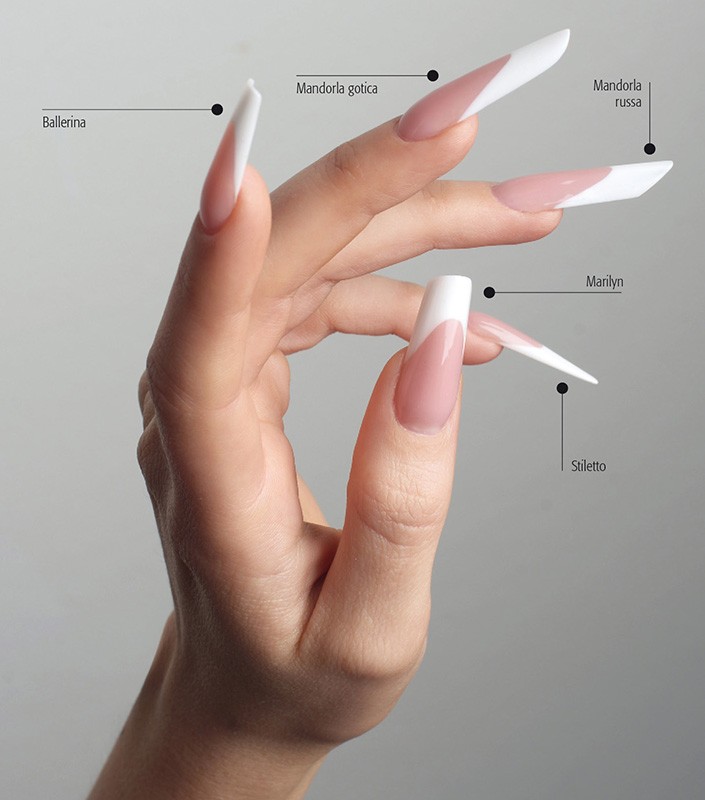
French Manicure: All types of a timeless classic

Welcome back!

Today I want to talk about the best known nail art: French Manicure.

I will illustrate the various typologies and I will explain in short the realization, let’s start!

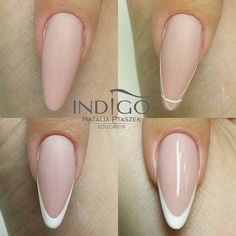
French in Surface

This is the easiest to make and in the salons it is the most common one, for the speed of realization.

This typology can be realized both with polish, gel polish, gel and acrylic.

This is because you can draw it on a nude toned color or pink base, the white edge on the tip.

Easy to make, in the salons it is often made also for the convenience in the removal, since it is drawn on the surface.

Deep French

The Deep French is achievable in combination with a reconstruction.

After performing the stretch, proceed using a white gel or acrylic builder to create the edge.

All this before creating the apex, for this it takes the name of deep.

So once you have drawn the edge with white, you can proceed with the structure above, with a clear builder.

This type of French is recommended for those with a rather long nail bed by nature.

Deep and Reverse French

The procedure of this type is very similar to the previous one, but has variations.

Also this must be created below the structure and on a stretch in gel or acrylic.

In addition, you need to create what is called a “wall”, with a gel cover.

The gel cover is pink and you need to create the inverse of the white edge.

Once you have created this guideline, just place the white builder next to the pink one and you’re done.

This technique is used to create French on nail beds with color alterations, or on the most extreme and long forms.

Both this type and the previous one require more time and in the refill they will never be completely eliminated, because below the structure itself.

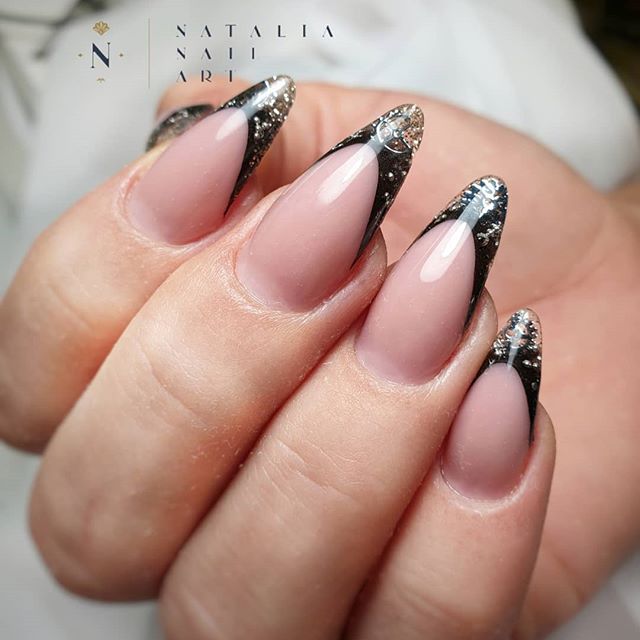
Speaking of french, we think of white to create the edge but of course we can choose the colors we prefer.

In the end the result should always be the same, without noticing the difference in technique used.

That’s all for today’s article, I hope I have clarified any doubts about the difference between the three techniques.

If you liked the article, share it and like it, see you soon!

SOFIA