Archivi tag: job

Nail coating with reinforced gel polish

Hello everyone and welcome back to my blog!

Today we are talking about this new technique which has been making its way for some time.

Let’s begin!

What’s this

This technique offers a natural look on the nails, as if you were wearing the gel polish, but also more resistant, as if it were a gel coating.

In addition, it can be removed by dissolving it and does not require filing of the structure.

This treatment is recommended for those who want to wear gel polish but have brittle nails.

We know that gel polish on problematic nails does not have excellent adhesion, so you can opt for this new procedure.

What is needed

To achieve this, specific bases must be purchased.

By now almost all brands have them, and these are thicker and fuller bases, which allow you to easily create a small reinforcement on the nail.

Some brands also create these products to create small stretches, of maximum 3 millimeters.

Pocedure

After preparing the nail with the preparers indicated by the company, a thin base layer is created first, so that the product that we will apply later can slide.

Without catalyzing, a greater quantity of gel polish is applied, to create what could be a small apex, in order to guarantee maximum resistance.

In general, these products are very self-leveling and create the structure themselves.

So once catalyzed there should be no need to file, it is still recommended buffer in order to allow a better adhesion of the color.

In the end it is an excellent alternative to gel covers that have a slightly longer process.

Today’s article ends here, I hope it was useful.

If you want to see how to work this product, you can watch my latest video on my youtube channel, I leave you the link here.


If you liked this article, leave a like and share.

Don’t forget to follow me on Instagram and on my Youtube channel.

See you next time!

SOFIA

Dolori fisici da onicotecniche: consigli per prevenirli e limitarli

Bentornati sul mio blog!

Oggi voglio parlare di un’argomento molto importante, la salute delle onicotecniche.

Questo lavoro ci porta a stare ore e ore sedute, spesso concentrate su un lavoro, tanto che non ci accorgiamo di alcune cattive posture o abitudini abbiamo.

Vedremo cosa è meglio e cosa non è meglio fare, per preservare la nostra salute, e soprattutto ad esempio, la sindrome del tunnel carpale.

Iniziamo!

1.

Dal momento che alcuni problemi possono incorrere dalla torsione scorretta, mantenete gli oggetti ben di fronte a voi, evitate di tendere ad un lato. Inoltre evitate di torcere anche il collo, come se stesse tenendo il telefono con una spalla. La testa dovrebbe essere tenuta dritta e le spalle rilassate.

2.

Evitate di allungarvi, per più di 30 cm, e mantenete gli avambracci paralleli al pavimento. Questa è detta “posizione neutrale”.

3.

Scegliete delle sedie di qualità, preferibilmente quelle rotanti, che abbiano la seduta un po’ più larga delle vostre cosce, e aggiustate la sua altezza, in modo che le cosce siano parallele al pavimento con tutta la superficie dei piedi che tocca per terra.

4.

Non incrociate le gambe e utilizzate tutta la seduta della sedia, senza sedersi lateralmente. Assicuratevi inoltre che essa sia ben imbottita, in modo da non creare pressione sulla parte posteriore delle gambe o ginocchia.

5.

Minimizzate altri punti di pressione, quindi non tenete le braccia sullo spigolo del tavolo. Potete usare della spugna o imbottiture sul bordo del tavolo, in modo da evitare tutto ciò.

6.

Evitate di pendere in avanti o indietro. La testa, il collo e il corpo dovrebbe essere ben dritto, senza torcersi o incurvarsi.

7.

Invece di torcere il vostro corpo, per lavorare, gentilmente posizionate la mano o il piede della cliente in modo che voi siate più confortevoli possibili. Durante le pedicure è importante usare sedie reclinabili che aiutano e supportano bene le gambe della cliente.

8.

Usa un cuscino, da appoggiare sulla zona lombare, in modo da allentare la pressione.

9.

Le mani e i polsi devono essere tenuti dritti, non piegati o storti lateralmente.

10.

Mentre tenete la mano o il dito della cliente, posizionatelo in modo che minimizzate la pressione della tenuta. Tenetela invece in modo delicato e rilassato, per ridurre lo sforzo.

Ecco qua, questi sono alcuni consigli che sicuramente vi faciliteranno il lavoro!

L’articolo di oggi finisce qui, se vi è piaciuto lasciate un like e condividetelo!

Non dimenticatevi di seguirmi su Instagram e sul mio canale youtube.

Alla prossima!

SOFIA

Physical pains of nail technicians: tips to prevent and limit them

Welcome back to my blog!

Today I want to talk about a very important topic, the health of nail technicians.

This job leads us to spend hours and hours sitting, often concentrated on a job, so much so that we don’t notice some bad postures or habits we have.

We will see what is better and what is not better to do, to preserve our health, and especially for example, carpal tunnel syndrome.

Let’s begin!

1.


Since some problems can occur from incorrect twisting, keep the objects well in front of you, avoid tending to one side. Also avoid twisting your neck, as if he were holding the phone with one shoulder. The head should be kept straight and the shoulders relaxed.

2.


Avoid stretching for more than 30 cm and keep your forearms parallel to the floor. This is called “neutral position”.

3.


Choose quality chairs, preferably the rotating ones, which have the seat a little wider than your thighs, and adjust its height, so that the thighs are parallel to the floor with the whole surface of the feet touching the ground.

4.


Do not cross your legs and use the whole seat of the chair, without sitting sideways. Also make sure that it is well padded, so as not to create pressure on the back of the legs or knees.

5.


Minimize other pressure points, so don’t keep your arms on the edge of the table. You can use sponge or padding on the edge of the table, in order to avoid this.

6.


Avoid leaning forward or backward. The head, neck and body should be straight, without twisting or bending.

7.


Instead of twisting your body, to work, kindly position the client’s hand or foot so that you are as comfortable as possible. During pedicures it is important to use reclining chairs that help and support the client’s legs well.

8.


Use a pillow, to be placed on the lower back, in order to release the pressure.

9.


Your hands and wrists should be kept straight, not bent or twisted sideways.

10.


While holding the client’s hand or finger, position it so that you minimize the pressure of the seal. Instead, keep it gently and relaxed to reduce strain.

Here you are, these are some tips that will surely make your job easier!

Today’s article ends here, if you liked it, leave a like and share it!

Don’t forget to follow me on Instagram and on my youtube channel.

See you next time!

SOFIA

Partecipo al mio primo nail contest

Buongiorno a tutti!

Oggi voglio raccontarvi di un’esperienza a cui ho partecipato: il mio primo nail contest!

Iniziamo!

Cos’è

In generale un nail contest è una competizione amichevole tra tutte le onicotecniche o comunque ragazze che vogliono partecipare che sono appassionate al mondo delle unghie.

Dato che siamo tutti a casa, questo è un modo per svagarsi e concentrare le nostre forze su un qualcosa che ci appassiona.

Io tra i tanti concorsi che c’erano, ho deciso di partecipare a quello di Valentina Colonna, in collaborazione con l’azienda che rappresenta, Mistero Milano.

Mi piaceva ciò che aveva proposto quindi ho scelto di partecipare e il tema era la Bellezza.

Ognuno poteva realizzare ciò che al meglio rappresentasse la bellezza e io mi sono data alla pazza gioia!

Prima proposta

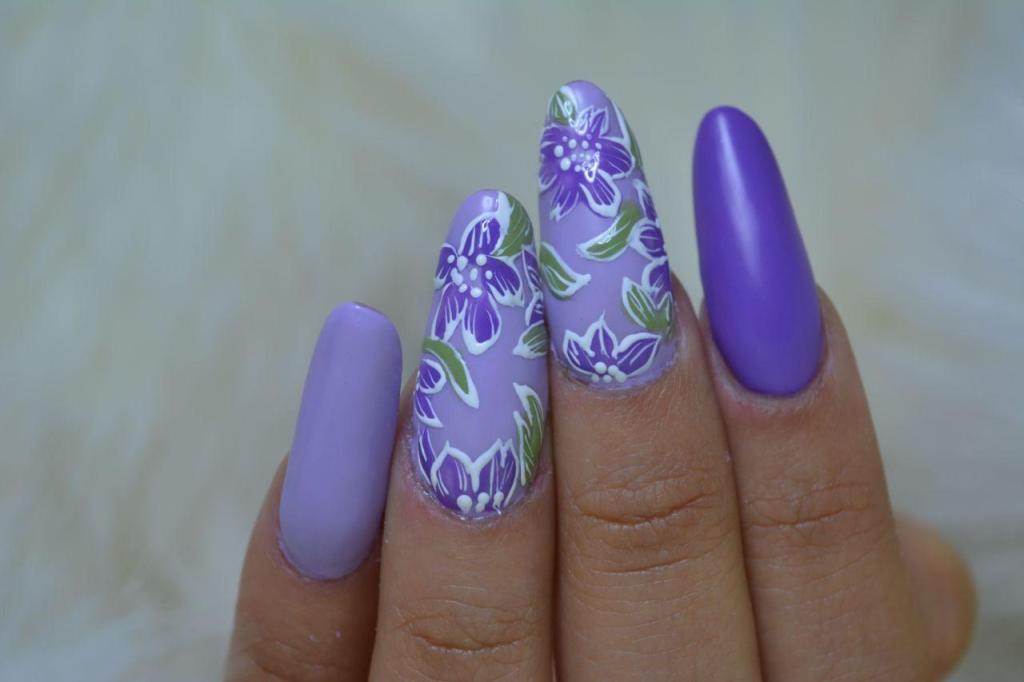
Ecco le prime unghie che ho realizzato.

Sapete tutti che adoro il viola e quindi ho deciso di utilizzare questo bellissimo colore e realizzare una nail art semplice e ad effetto.

I fiorellini danno quel tocco di delicatezza e armonia in piu!

Seconda proposta

Sempre sulla stessa ricostruzione, dopo aver eliminato il vecchio colore, ho deciso di realizzare qualcosa di più complicato.

Io adoro dipingere, non solo le unghie, e nel mio tempo libero su delle tele creo dei paesaggi naturali.

Mi sono anche posta una sfida, ovvero se riuscivo a farlo su una superficie più piccola come le unghie, utilizzando la pittura acrilica.

Ho realizzato qualcosa di tropicale, che mi ricordasse l’estate, stagione che io adoro.

Se volete sapere come utilizzare la pittura acrilica sulle unghie, leggete questo articolo.

Terza proposta

La bellezza sta anche nelle cose più geometriche e astratte.

Quindi sempre utilizzando una tonalità di viola, su una mandorla più corta, ho creato questo decoro, semplice ma lineare.

Quarta proposta

Be avevo pensato che avrei voluto combinare tutto ciò che mi piace sulle unghie.

Il viola, i glitter, gli swaroski, le forme estreme etc..

E questo è ciò che ne è uscito.

Ci ho messo 5 ore, perchè era una cosa abbastanza complessa da realizzare, però ne sono molto soddisfatta e mi piace molto.

Ecco qua le mie proposte per un contest, siate liberi di prendere tutte le idee che volete!

Vi piacciono?

Se questo articolo vi è piaciuto lasciate un like e condividete.

Non dimenticatevi di seguirmi su Instagram e sul mio canale Youtube.

Alla prossima!

SOFIA

My first nail contest!

Goodmorning everyone!

Today I want to tell you about an experience in which I participated: my first nail contest!

Let’s begin!

What’s this


In general, a nail contest is a friendly competition between all nail technicians or girls who want to participate who are passionate about the world of nails.

Since we are all at home, this is a way to relax and focus our strength on something we are passionate about.

Among the many competitions that were there, I decided to participate in that of Valentina Colonna, in collaboration with the company it represents, Mistero Milano.

I liked what she proposed so I chose to participate and the theme was Beauty.

Everyone could achieve what beauty best represented and I gave myself to crazy joy!

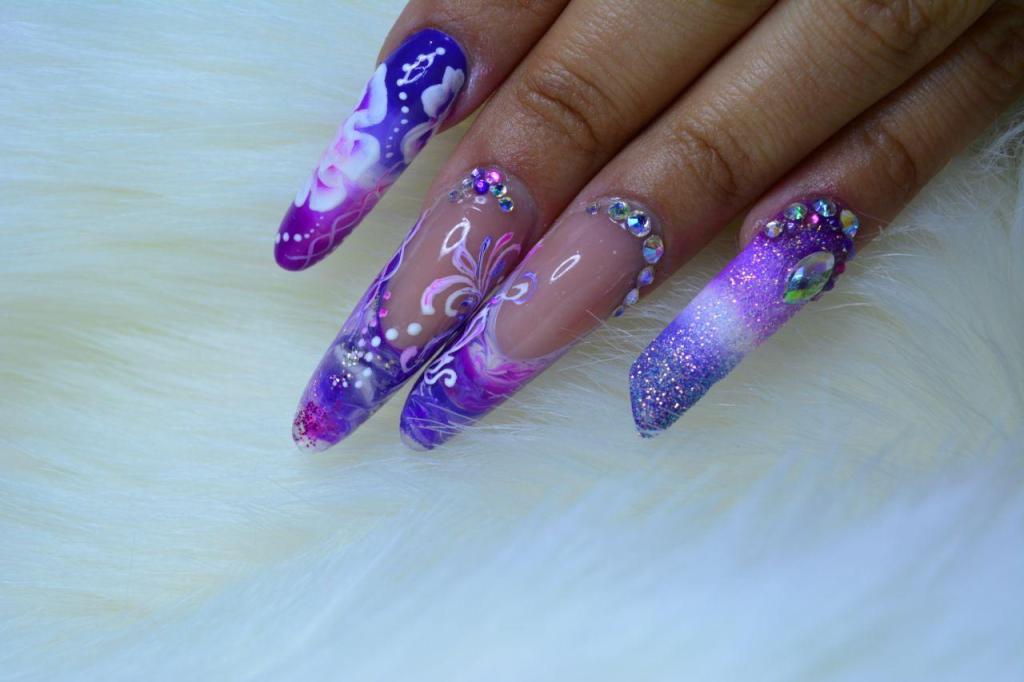
First idea

Here are the first nails I made.

You all know that I love purple and therefore I decided to use this beautiful color and create a simple and effective nail art.

The flowers give that extra touch of delicacy and harmony!

Second idea

Still on the same reconstruction, after eliminating the old color, I decided to make something more complicated.

I love painting, not only nails, and in my free time I create natural landscapes on canvases.

I also asked myself a challenge, that is, if I could do it on a smaller surface like nails, using acrylic paint.

I made something tropical, which reminded me of summer, a season that I love.

If you want to know how to use acrylic paint on nails, read this article.

Third idea

Beauty also lies in the most geometric and abstract things.

So always using a shade of purple, on a shorter almond, I created this decoration, simple but linear.

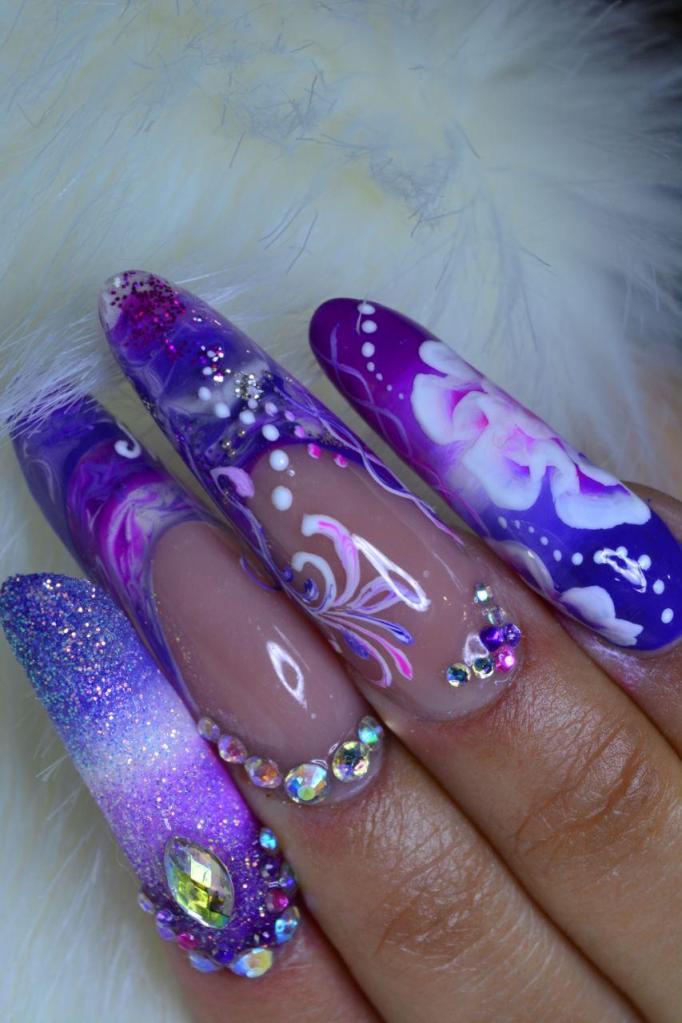
Fourth idea

Well I thought I wanted to combine everything I like on the nails.

Violet, glitter, swaroski, extreme shapes etc ..

And this is what came out of it.

It took me 5 hours, because it was a complex enough thing to do, but I am very satisfied with it and I really like it.

Here are my proposals for a contest, be free to take all the ideas you want!

Do you like them?

If you liked this article, leave a like and share.

Don’t forget to follow me on Instagram and on my Youtube channel.

See you next time!

SOFIA

Come realizzare la french con il muretto

Come realizzare la french con il muretto

Ciao a tutti e bentornati sul mio blog.

Oggi voglio spiegarvi come si realizza un french con la tecnica muretto.

Se volete sapere quali tipi di french esistono vi invito a leggere questo articolo.

Iniziamo!

Preparazione dell’unghia

Come in ogni ricostruzione o copertura dell’unghia naturale bisogna prima occuparsi della preparazione dell’unghia.

Spingo le cuticole, rimuovo quelle attaccate alla lamina ungueale e opacizza l’unghia naturale.

Applico i preparatori quindi nail prep e primer. In caso di necessità applico anche il primer non acido.

Applico la base.

Allungamento

Dopo aver adattato nel migliore dei modi la cartina alla nostra unghia la inserisco e creo un allungamento della lunghezza e della forma che desideriamo.

L’importante è che sia molto sottile.

Muretto con cover rosa

Dopo aver rimosso la cartina ci occupiamo della allungamento del letto ungueale.

Questa tecnica si utilizza quando dobbiamo realizzare un french che è abbastanza lungo. Se immaginiamo di creare una lunghezza notevole su un unghia che ha un letto ungueale corto, il french risulterebbe sproporzionato.

Quindi con il cover rosa di un colore a nostra scelta possiamo allungare otticamente il letto ungueale.

Bisogna fare attenzione a scegliere un cover costruttore. Possibilmente consiglio di utilizzare uno che ha una densità abbastanza alta.

Stendo il primo strato a smalto in modo da uniformare il colore dell’unghia naturale e aiutarmi nella stesura e lavorazione del prodotto successivo.

Prelevo una quantità abbastanza abbondante di gel rosa e lo applico dove voglio che finisca è il mio letto ungueale.
Lo lavoro creando una linea del sorriso è abbastanza profonda e allungata.

Volendo posso già iniziare a creare un po’ di bombatura. Non è un problema si potrebbe anche scegliere di stenderlo vicino al giro cuticole abbastanza sottile e poi ricreare in seguito con un Builder trasparente la bombatura.

Il prodotto deve essere abbastanza spesso sul sorriso.

Limatura muretto

Una volta che abbiamo catalizzato e sgrassato passiamo alla limatura del muretto muretto.

Con una lima posizionata parallela al prodotto iniziamo a definirci in modo preciso la linea del sorriso in modo che poi applicando il colore e sa risulterà ben dritta.

Inoltre se ne ho bisogno limo anche la superficie del muretto uniformando il prodotto su tutta l’unghia.

Colore

Abbiamo quindi creato uno spazio vuoto per applicare il colore a nostra scelta.

Abbiamo varie alternative.

Si può utilizzare un costruttore bianco, un gel color o un semipermanente oppure volendo dei glitter.

Il mio caso vi spiegherò quei glitter ma il procedimento è lo stesso.

Con un pennellino sottile vado applicare sulla linea del sorriso il colore in modo pieno.

Senza prelevare altro colore con il pennellino ancora sporco sfumo quel che è già presente verso il margine libero.

Catalizzo il colore e applico uno strato leggero di Top Coat in modo da creare una superficie appiccicosa.
Scelgo i glitter di colore, forma e grandezza a mia scelta.

Li applico nel modo che preferisco e poi catalizzo.

Completamento struttura

Dopo di ciò dobbiamo andare a riempire il vuoto che si è creato tra il muretto e l’allungamento.

Utilizzo un costruttore trasparente.

Fate bene attenzione a non utilizzare quelli ad esempio con le fibre di vetro all’interno perché non saranno completamente trasparenti.

Vado quindi ad applicarlo dove manca il prodotto per livellare la superficie e nel caso in cui mancasse creo la bombatura.

Limatura e top coat

Limo quindi la superficie che è stata creata secondo le regole della forma che abbiamo scelto.

Infine applico il top coat.

Ecco qua il risultato della mia french con tecnica a muretto.

Vi piace?

Se volete vedere realizzato questo unghia potete andare a guardare l’ultimo video sul mio canale youtube.

Vi lascio qui il link.

Se questo articolo Vi è piaciuto lasciate un like e condividete.

Non dimenticatevi di seguirmi su Instagram sul mio canale youtube.

Alla prossima!

SOFIA

How to make deep French

Hello everyone and welcome back to my blog.

Today I want to explain how a French is made with the wall technique.

If you want to know what types of French exist, I invite you to read this article.

Let’s begin!

Nail preparation

As in any nail reconstruction, you must first deal with the preparation of the nail.

I push the cuticles, remove those attached to the nail plate and mattify the natural nail.

I apply the nail prep and primer. If necessary, I also apply the non-acid primer.

I apply the base.

Length

After adapting the nail form in the best way, we attach it to our nail and create an extension of the length and shape we want.

The important thing is that it is very thin.

Wall with pink cover

After removing the nail form we take care of the lengthening of the nail bed.

This technique is used when we have to make a french that is long enough. If we imagine to create a considerable length on a nail that has a short nail bed, the French would be disproportionate.

So with the pink cover of a color of our choice we can optically lengthen the nail bed.

I possibly recommend using a gel that has a fairly high density.

I spread the first in a thin layer in order to uniform the color of the natural nail and help me in the drafting and processing of the next product.

I take a fairly large amount of pink gel and apply it where I want it to end is my nail bed.
Create a smile line quite deep and elongated.

If you want, I can already start creating a little apex. It is not a problem you could also choose to spread it close to the cuticle quite thin and then recreate the apex later with a transparent Builder.

The product must be thick on the smile line.

Wall filing

Once we have catalyzed we move on to the filing of the wall.

With a file positioned parallel to the product we begin to define precisely the smile line so that when applying the color it will result straight.

In addition, if I need it, I also file the surface of the wall by uniforming the product on the entire nail.

Color

We therefore created an empty space to apply the color of our choice.

We have various alternatives.

You can use a white builder you can use a color gel or a gel polish, or use glitter.

In my case I will explain those glitter but the procedure is the same.

With a thin brush I go to apply fully the color on the smile line.

Without taking other color with the brush still dirty I blend what is already present towards the free margin.

I catalyze the color and apply a light layer of Top Coat to create a sticky surface.
I choose the color, shape and size glitter of my choice.

I apply them in the way I prefer and then I catalyze.

Completion of the structure

After this we must go to fill the void that has been created between the wall and the nail.

I use a transparent builder.

Be careful not to use those with glass fibers inside for example because they will not be completely transparent.

I then go to apply it where there is no product to level the surface and in case it is missing I create the apex.

Filing and top coat

I file then the surface that was created according to the rules of the shape we have chosen.

Finally I apply the top coat.

Here is the result of my french with wall technique.

Do you like it?

If you want to see this nail made you can go to watch the latest video on my youtube channel.

I’ll leave the link here.

If you liked this article, leave a like and share.

Don’t forget to follow me on Instagram on my youtube channel.

See you next time!

SOFIA
Come realizzare fiori 3D

Bentornati Sul mio blog.

Oggi voglio spiegarvi come potete realizzare in modo facile e veloce dei fiori in 3D senza utilizzare l’acrilico.


Spesso si utilizza l’acrilico Perché col fatto che polimerizza all’aria è più facile gestire il prodotto, ma oggi vi farò vedere come poterlo fare con la plastilina e l’acrygel.


Iniziamo!

Plastilina

Per realizzare questa rosa con la plastilina ho scelto di utilizzare quella colorata di rosa. Esistono in commercio vari colori potete scegliere voi quali preferite. Oppure potete sceglierne uno neutrale e poi colorare la rosa.

Per realizzare la rosa utilizzo il retro di una cartina, potete usare anche la cartina stessa.

Inizio realizzando il pistillo.


Con un dotter prelevo una piccola quantità di prodotto e la appoggio sul pezzo di carta. Dopodiché con un pennello imbevuto di cleaner modello la plastilina in modo da formare un pistillo.

Lo polimerizzo.

Dopodiché prelevo un’altra quantità, un po’ più abbondante di prodotto e la appoggio sul pezzo di carta. Con il cleaner e il pennello la appiattisco in una forma abbastanza rotonda.

Faccio polimerizzare per circa 5 secondi e dopodiché tiro fuori il prodotto dalla lampada.
In questo momento è ancora molto morbido ma non troppo.
Con un pennello sollevo i lembi del cerchio in modo da cercare di unirli alla base formando una specie di triangolo è in questo modo si vedrà come si forma il petalo.

Una volta che ho finito di modellarla, la sollevo delicatamente, mi aiuto con una pinza per reggere il prodotto e la metto in lampada.

Ripeto lo stesso procedimento.
Una volta che però ho modellato i lembi del cerchio sollevo il prodotto e lo faccio polimerizzare insieme a petalo già creato. Li unisco alla base, aiutandomi con una pinzetta, e li lascio polimerizzare in quella posizione.

Quindi continuo così finché sono soddisfatta del fiore realizzato.

Per attaccare il fiore sull’unghia utilizzo del Poligel trasparente.
Ne applico una piccola quantità dove desidero che il fiore stia e in seguito ci appoggio la rosa. Lascio polimerizzare.

Quindi eseguo lo stesso procedimento con l’acrygel.

Acrygel

C’è poca differenza tra i due materiali, ho comunque deciso di realizzare una rosa diversa con l’acrygel.

Ecco il risultato.

Si presentano così a confronto.

Se volete vedere in pratica tutte le cose che ho spiegato adesso, potete andare a vedere il mio ultimo video su YouTube.
Nella sfida che realizzo, creò anche delle rose con l’acrygel.

L’articolo di oggi è finito. Spero che sia stato utile.


Se vi è piaciuto lasciate un like e condividete.


Non dimenticatevi di seguirmi su Instagram e sul mio canale YouTube.

Alla prossima!

SOFIA

How to create 3D flowers

Welcome back On my blog.

Today I want to explain how you can make 3D flowers quickly and easily without using acrylic.


Acrylic is often used because with the fact that it polymerizes in the air it is easier to manage the product, but today I will show you how to do it with plasticine and acrygel.


Let’s begin!

Plasticine

To make this rose with plasticine I chose to use the rose colored one. There are various colors on the market, you can choose which ones you prefer. Or you can choose a neutral one and then color the rose.

To create the rose I use the back of a nail form, you can also use the nailform itself.

I start by making the pistil.
With a dotter I take a small amount of product and place it on the piece of paper. Then with a brush soaked in cleaner model the plasticine so as to form a pistil.

Then I take another quantity, a little more abundant of product and place it on the piece of paper. With the cleaner and the brush I flatten it in a fairly round shape.

I let it cure for about 5 seconds and then I take the product out of the lamp.
At the moment it is still very soft but not too soft.
With a brush I lift the edges of the circle so as to try to join them to the base forming a kind of triangle and in this way you will see how the petal is formed.

Once I have finished modeling it, I gently lift it, use a pair of pliers to hold the product and put it on the lamp.

I repeat the same procedure.
Once I have modeled the edges of the circle, I lift the product and polymerize it together with the petal already created. I join them to the base, helping myself with tweezers, and let them cure in that position.

So I continue like this until I am satisfied with the flower made.

To attach the flower to the nail, use transparent Poligel.
I apply a small amount where I want the flower to stay and then I support the rose. I let it cure.

Acrygel

So I carry out the same procedure with the acrygel.

There is little difference between the two materials, however I decided to make a different rose with acrygel.

Here is the difference between acrygel and plasticine.

If you want to see practically all the things I have explained now, you can go and see my latest video on YouTube.
In the challenge I realize, he also created roses with acrygel.

Today’s article is finished. I hope it was useful.
If you liked it, leave a like and share.
Don’t forget to follow me on Instagram and on my YouTube channel.

See you next time!

SOFIA

Che tipo di unghia hai?

Bentornati sul mio blog!

Oggi voglio fare una panoramica sulle varie tipologie di unghie che ci si possono presentare davanti, in modo da risconoscerle e poi scegliere il miglior trattamento.

Iniziamo!

Unghia quadrata

In generale quest’unghia è la più bella da trattare.

Presenta i laterali pieni, dunque le spaccature sono più improbabili.

Ha una superficie che appare sana e rosata, con la giusta quantità di cuticole.

Presenta una curva c morbida, la zona stress si presenta più anteriormente, verso il margine libero e queste sono unghie mediamente robuste.

Unghie ovali

Di unghie ovali ne esistono di due tipi.

Un tipo presenta le stesse caratteristiche che abbiamo citato prima dell’unghia quadrata, quindi non risulta essere problematica.

È presente anche un altro tipo.

Data la forma ovale, non presenta i laterali dell’unghia. Ciò può far avvenire delle rotture dell’unghia.

La superficie appare più rossa del solito, questo perché sono unghie sottili e secche.

Inoltre tendono a crescere verso il basso e potrebbero presentare cuticole abbondanti.

La curva a c non è dolce bensì molto arcuata.

Il punto di stress è più vicino al girocuticole.

Solitamente queste unghie le ritroviamo su mani grandi.

Unghia stretta in cima e larga in fondo

Queste unghie a differenza delle altre non presenta ne una curva a c ne la zona di stress.

Sono unghie che principalmente tendono a crescere verso l’alto, dunque assumono una forma tendenzialmente concava.

Queste unghie sono molto sottili, quindi appariranno più rosse del normale.

Sono presenti su chi ha mani piccole e unghie piccole.

Unghie onicofagiche

Una persona onicofagica non presenterà delle unghie lunghe abbastanza per farci capire in principio che lamina presentava.

Però lo si può capire dal letto ungueale.

Se esso è piccolissimo, e l’unghia è già molto spostata verso il margine libero, allora con tutta probabilità questa persona presentava unghie piccole che vanno verso l’alto.

Invece chi ha un letto ungueale più ampio, con il polpastrello che è gonfio e va a proteggere l’unghia, probabilmente aveva un unghia quadrata.

Queste sono le unghie più comuni che possiamo trovarci davanti.

Ovviamente quel che ho scritto può avere delle eccezioni e non essere sempre vero, ma generalmente parlando è così.

Spero che questo articolo vi sia stato utile.

La settimana prossima parlerò di che prodotti usare su ogni tipo di unghia, in modo da garantire la migliore durata e aderenza.

Se questo articolo vi è piaciuto lasciate like e condividete.

Non dimenticatevi di seguirmi su Instagram e sul mio canale YouTube.

Alla prossima!

SOFIA